
History & Claims
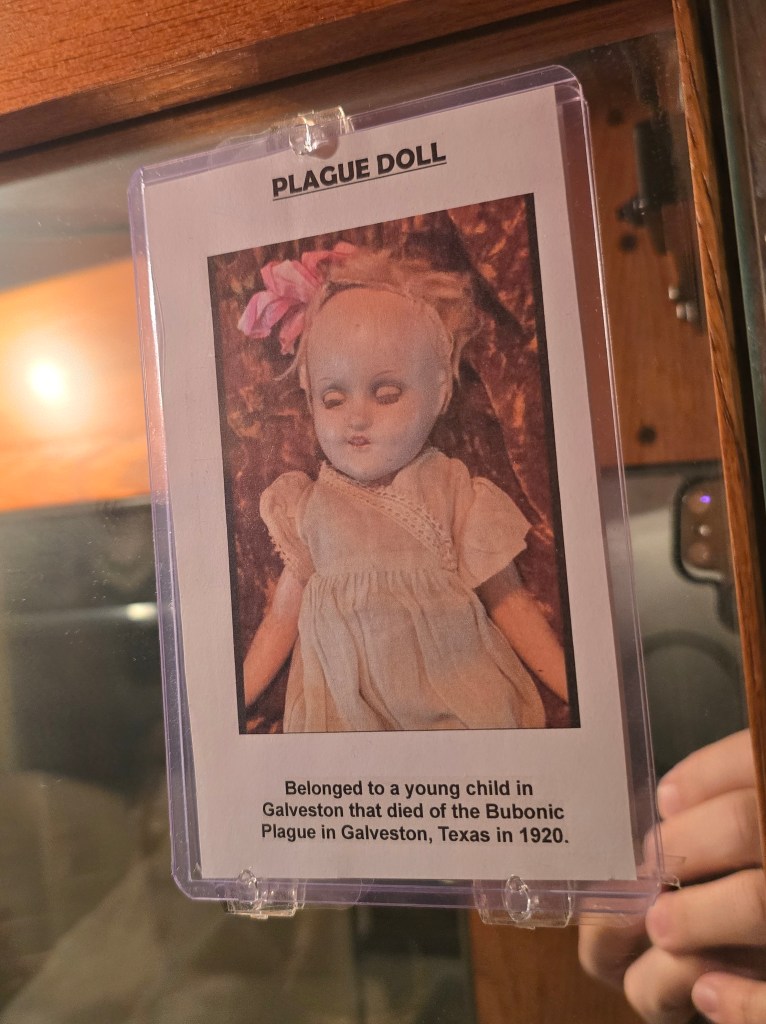
BUBONIC PLAGUE, GALVESTON (1920).Bubonic plague
appeared in Galveston, Texas, in early June 1920. This outbreak is considered to be part of the third pandemic which started in China in 1894 and moved westwards. At the time it arrived in Galveston, bubonic plague was also present in the Gulf ports of Beaumont, Texas; Pensacola, Florida; New Orleans, Louisiana; and Vera Cruz, Mexico. The distribution of the outbreaks was suggestive of a common source, but it was never discovered.
Bubonic plague, called “Black Death” during the medieval period, is caused by the bacteria Yersinia pestis and is primarily a disease of rodents-rats are the principal carriers. The infection is carried from rat to rat by the flea (Ceratophyllus fasciatus or less commonly the Lemopsylla cheopsis [which was found frequently in Galveston]). The fleas feed on the blood of a plague-infested rat. After the death of the rat, the fleas leave and seek other rats, or when a human comes in close contact with a dead rat, the flea may attach itself to the human. On biting, or puncturing the skin, the flea regurgitates or defecates the bacteria into the wound; sometimes a tiny pustule is visible. The bacteria can also be transmitted by direct contact with infected tissue or fluids, or by droplet inhalation, called pneumonic plague. The first change noted in the human is a swelling or bubo in the lymph glands (clusters are found in the underarms, groin, neck, chest, and abdomen). As fleas characteristically attach themselves to the legs, the femoral group of glands (located in the groin) are most often involved.
Between June 16 and November 13, 1920, seventeen human cases of bubonic plague and one pneumonic plague acquired in Galveston were documented.
The first victim, a seventeen-year-old male, worked as a collector in Davison & Company grain and feed store on 29th and Strand Street. Onset of symptoms began on June 8, 1920, when he felt dizzy, cold, and had a swelling or “bubo” of his right femoral gland. A dead rat and numerous fleas were found at his place of occupation. By June 16 he was unconscious and was admitted to the isolation ward of the John Sealy Hospital in Galveston. He died four hours after admission. Two hours later, pathologist Henry C. Hartman began the autopsy. During this period, diagnosis of plague was frequently made through gland puncture. A needle, attached to a syringe was inserted into the femoral bubo, some of the gland juice was aspirated into the syringe, and a drop was smeared onto a clean microscope slide. The slides were stained and fixed over an open flame and then examined for swollen bacilli. The remaining juice was diluted with saline solution and injected into a guinea pig. A day or so later, the inoculated guinea pig developed swollen glands, confirming a clinical diagnosis of bubonic plague. The seventeen-year-old man was the first victim of the 1920 outbreak of bubonic plague in Galveston. He was buried on the island’s Lake View Cemetery on June 17 at 10:00 P.M. to avoid public panic.
The following day, June 18, 1920, the Galveston Daily News headlined, “WHAT MAY BE BUBONIC PLAGUE IS FOUND HERE.” The following day, a second case was reported. A twenty-five-year-old woman, who sewed feedbags at Davison’s grain store was diagnosed with bubonic plague. She was admitted to the John Sealy Hospital and was suffering from a fever and swollen lymph glands. The patient was given Mulford’s anti-plague serum intravenously and survived. After the first case of bubonic plague was diagnosed, Mulford’s anti-plague serum was made available by the state of Texas. An abundance of serum was subsequently supplied by the Pasteur Institute in Paris, the Texas State Board of Health, and the United States Public Health Service.
Nine women and nine men, aged from three to seventy-nine years, contracted bubonic plague in Galveston; twelve died.
Their occupations were diverse and included a longshoreman, a waiter, a night watchman, and a pathologist
-Anna Mary Bowie, who accidentally infected herself during an autopsy via a needlestick injury. Between June and November 1920, eleven cases of plague were treated with anti-plague serum, and, of these, six died and five recovered.
Galveston officials immediately launched an anti-plague ”WAR ON RATS” campaign in the aftermath of the first death. A plague laboratory located at Twentieth Street and Avenue C (Mechanic Street) was established through the cooperation of the city of Galveston, the Texas State Board of Health, and the United States Public Health Service under the leadership of Mark F. Boyd, M.D. The city employed forty rat trappers, and the general public was encouraged to trap and kill rats, dip them in gasoline or kerosene, record their location on a tag, and drop them off at the plague laboratory for examination by Boyd and his colleagues. From the start of “anti-plague operations” in early July through December 1920, 46,623 rats were examined in the laboratory (a total of 67 exhibited plague symptoms-66 were Mus norvegicus and one was Mus rattus). On November 13, 1920, a ten-year-old school boy ”who frequented the wharfs” was the last victim to die of bubonic plague in Galveston, 1920.
Extensive rat trapping, the removal of rat harborages, and the fumigation of buildings and shipping helped defeat the plague in Galveston. Evidence of the 1920 outbreak of bubonic plague in Galveston can still be seen in rat-proofed structures. Rat ordinances were enacted whereby after October 1920 all buildings, outhouses, stables, and super structures had to be rat-proofed with concrete structures. Between 1900 and 2012, 1,006 confirmed or probable human plague cases occurred in the United States. On average, between one to seventeen cases of bubonic plague are recorded in the United States annually. Today, antibiotics are used to treat patients diagnosed with bubonic plague. The earlier the medication is administered, the better the chances that the patient will make a full recovery.
Medium Impressions by Violet Bloom

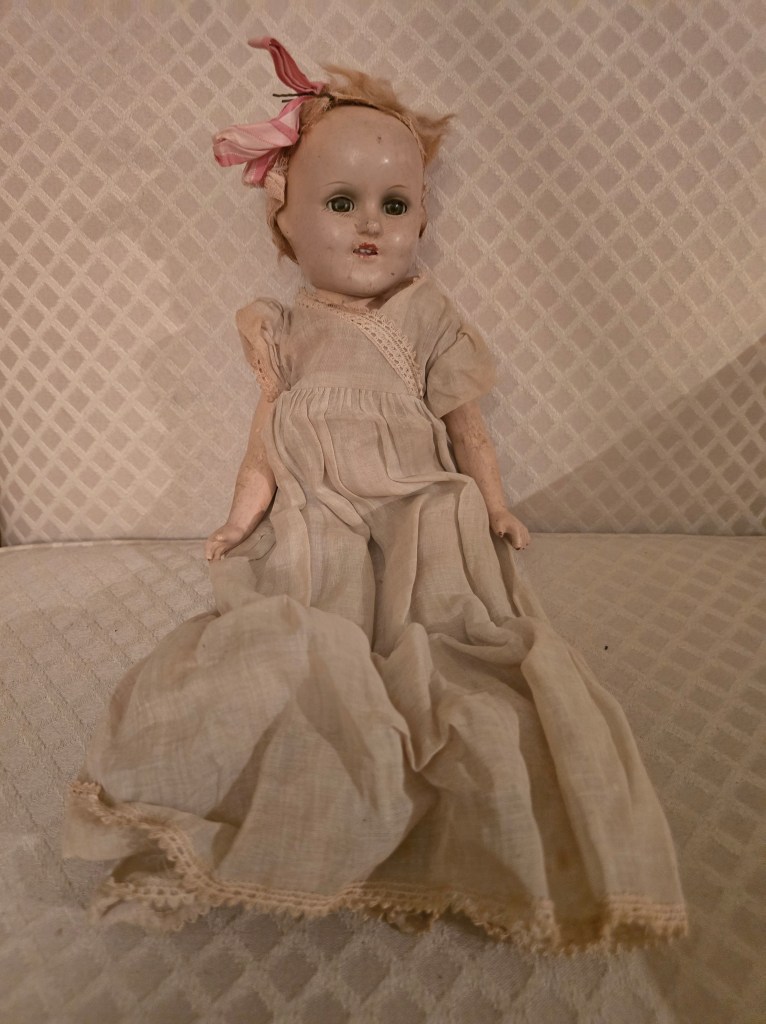
In the world of haunted dolls, sleepy-eye dolls have the highest propensity for paranormal activity because their eyes open and close. Traditionally when you sit them up, sleepy-eye dolls open their eyes and when they lie down, their eyes close.
I am here to tell you little Gilda here, is a candidate for fluttering her eyes at will and she will enjoy surprising you. I can tell you from personal experience if you see the eyes of a doll open and close, it will be a thrilling experience, especially, after you finally convince yourself that you saw what you saw.
The information that I picked up from this spirit was that her name was Gilda. This beautiful German doll with little teeth was made in the early 1900s and was one of Gilda’s personal favorites. Gilda was only 10 years old when she died. She lived in Galveston, Texas with her family. And Gilda died from septic pneumonia only two days after she began feeling sick.
Gilda became critically ill, delirious with a high fever, severe stomach pain, and bleeding into the skin, causing dark discoloration in her fingers and toes. At first, they may have thought she had the bubonic plague, but she didn’t have the characteristic big bumps in the lymph nodes of her armpits, groin, or neck.
Septicemia is also known as blood poisoning and is caused by bacteria in the blood. In Gilda’s case, the infection quickly spread to her lungs and the poor little thing died gasping for air.
Gilda was quite a little prankster in life, so you may notice that little things you use every day may have been moved. You may hear giggling and running through the house. If you have pets, that will be a big plus for her-she loves cats and dogs and would do cartwheels for a miniature horse.
Gilda is a sweet little spirit and her life was taken much too soon. It will be easy to love her. She is a delight. She will make a wonderful spirit companion and will appreciate everything you do for her.
 The Spirits Within